
Garage, basement and commercial floors around Allegheny County
Epoxy Flooring in Pittsburgh, PA
Coatings chosen for salted slush, damp hillside basements and gray, slow-drying weather, laid over properly ground concrete.
- Free on-site estimates
- Every slab gets a moisture reading before we coat it
- Written quotes that spell out the surface prep
Concrete Coatings Built for Western Pennsylvania Winters
Epoxy flooring in Pittsburgh has to stand up to a long, gray, salty winter before anything else. The city averages about 44 inches of snow a season, the January daily mean sits just under 29 degrees, and the sun shows for only about 45% of its possible hours. That adds up to slush on the tires from December into March, slabs that dry slowly and concrete that freezes and thaws over and over. Epoxy Flooring Pittsburgh installs epoxy floor coating, flake, polyaspartic and metallic systems on garages, basements, shops and commercial floors across the city and Allegheny County, and we choose each system after testing the slab, not before.
Why salt and freeze-thaw matter here
Road salt comes with living on these hills. In one hard winter, PennDOT had spread about 22,000 tons of salt in Allegheny County by late January, against roughly 5,000 tons at the same point a year earlier, according to WESA. Every car that pulls into a garage carries some of that brine. On bare concrete the salty water soaks in, freezes inside the pores and pops the surface off in flakes and pits, usually first near the door. A bonded coating seals the surface so meltwater pools on the film instead, ready to be pushed out with a squeegee. The word that matters is bonded. A coating rolled over dusty or sealed concrete lets go once hot tires and salt start working on it, which is why we diamond grind every floor.
Hills, basements and slow-drying slabs
Pittsburgh runs from about 710 to 1,370 feet in elevation and has roughly 800 sets of public outdoor stairs, so a lot of homes sit on slopes, with tuck-under garages and basements cut into the hillside. Below-grade concrete stays cool, and with average relative humidity near 68%, warm summer air can leave condensation on it. Moisture in the soil also pushes vapor up through older slabs, many of which went in without a vapor barrier. That is why every estimate starts with a moisture test. A slab that reads wet gets a primer formulated for vapor. If the slab is taking on liquid water, we tell you to fix the drainage first.
Epoxy, polyaspartic or polished concrete?
Homeowners often ask us to compare the three. Standard epoxy builds a thick, hard film, often 10 to 20 mils a coat, and suits basements, shops and rooms out of the sun. Its weak spot is sunlight: HomeGuide rates epoxy poor to fair for UV, so it can yellow where light reaches it. Polyaspartic goes on thinner, 2 to 6 mils a coat, rates excellent for UV and cures fast enough to park on within a day or two instead of up to a week. Polished concrete skips the coating and grinds the slab itself to a sheen. It can look sharp in a dry commercial space, but it does not seal the surface against salt brine the way a coating does, so we seldom suggest it for a garage that sees winter driving. A common garage build pairs an epoxy base, a flake broadcast and a polyaspartic topcoat.
What epoxy flooring costs
Most of the questions people search about this work are about price, so here are the published numbers. HomeGuide's published ranges: installed epoxy, $4 to $10 per square foot; a two-car garage, $1,600 to $5,800; polyaspartic, $5 to $12 per square foot. For a 1,000 or 1,500 square foot floor, multiply the square footage by that per-foot range. A 20 by 20 room comes to 400 square feet, which is in line with a typical two-car garage. Epoxy flooring cost goes up when old paint has to come off, when salt pitting needs patching (This Old House lists patching at $25 to $250) or when you add flake or metallic effects. Once we have seen your slab, the written number on our estimate is what you pay.
Garages, basements and businesses
Garages are the core of the work: one-, two- and three-car slabs that take salt, oil and the occasional snowblower. Basements are close behind, from laundry rooms to home gyms, where a light-colored floor brightens a room with small windows. On the commercial side, healthcare is one of the region's leading employers. UPMC alone employs about 48,000 people, and clinics, labs and back-of-house corridors need seamless floors that hold up to strong cleaners and rolling carts. Warehouses, loading areas, auto bays and workshops around the county need a hard-wearing concrete floor coating as well.
Weather on install day
Resin is fussy while it cures. In a cold garage in November or a muggy basement in July, the slab can sit at or below the dew point, and resin applied then may blush, cloud or lose its grip. Ahead of every coat we take readings of the slab, the air, the humidity and the dew point, run heaters or dehumidifiers when the space allows, and move the date when conditions are wrong. For an unheated garage, the months from late spring into early fall make scheduling simplest. Basements and heated spaces can usually be done any time of year.
Floods, radon and other things a coating will not fix
The rivers here have a long flood record. The March 1936 flood crested at 46 feet, and the remnants of Hurricane Ivan in September 2004 flooded about 4,000 homes in the county, according to WPXI. 2018 went down as Pittsburgh's wettest year on record. A coating protects a floor from spills, salt and wear, but it will not stop water coming through a foundation wall, and it is not radon mitigation. The Allegheny County Health Department notes that up to 40% of Pennsylvania homes may be above the EPA action level, so test a basement before you finish it. Should either problem show up during our visit, you hear about it from us before any money goes into a coating.
What to ask epoxy flooring contractors
Whether you call us or other epoxy flooring companies, ask everyone the same questions. How will the concrete be prepared: diamond grinding or acid etching? Will the slab be moisture tested, and what happens if it fails? How many coats, of which product, at what thickness? Which topcoat goes on a floor that sees sun or salt? How soon can you walk across it, return your belongings and pull the car in? Careful epoxy floor installers answer those in writing. Our quote lists every prep step, product and coat, with a single total at the bottom.
Common Questions
What does epoxy cost for a 1,000 square foot floor?
HomeGuide's installed range for epoxy is $4 to $10 per square foot, so multiply 1,000 by that range for a ballpark. Commercial floors that need 100% solids systems run higher; HomeAdvisor puts those at $12 and up per square foot. Grinding off old coatings and patching add to the total, and once we have measured, you get the price in writing.
What would a 20x20 epoxy floor run?
A 20 by 20 floor works out to 400 square feet, close to a standard two-car garage. HomeGuide lists a two-car garage at $1,600 to $5,800 for epoxy and $2,000 to $6,900 for polyaspartic. Where your floor lands in that range depends on its condition and the system you pick.
How much does a 1,500 square foot epoxy floor cost?
Floors that size are priced per square foot. HomeGuide puts epoxy at $4 to $10 and polyaspartic at $5 to $12 per square foot. At 1,500 square feet the floor is usually a large basement or a commercial space, so moisture readings and the number of coats drive the final number.
Does epoxy flooring have drawbacks?
Standard epoxy yellows in sunlight, can be slick when wet without added texture, and needs up to a week before you park on it. It also fails on concrete that is damp or poorly prepared. We deal with those by grinding every floor, testing moisture, adding grit to the topcoat and using a polyaspartic topcoat where UV or fast return to use matters.
Will road salt ruin a coated garage floor?
A fully cured, bonded coating resists salt brine far better than bare concrete, because the brine cannot soak in and freeze in the pores. Grit left sitting can dull the gloss over time, so give the garage a rinse or a squeegee pass now and then through the snowy months, and lay a mat beside the driver's door.
Is a damp basement floor still coatable?
Often, yes, if the dampness is vapor rather than flowing water. We take moisture readings, and a high one means a vapor-tolerant primer goes down first. If water actually comes in through the walls or floor, that repair comes before any coating, and we will say so plainly.
Can you install a floor in winter?
Basements and heated garages or shops, yes. An unheated garage in January is usually too cold for the resin to cure properly, so we schedule those for spring through fall or bring the space up to temperature first.
Our Epoxy Flooring Services
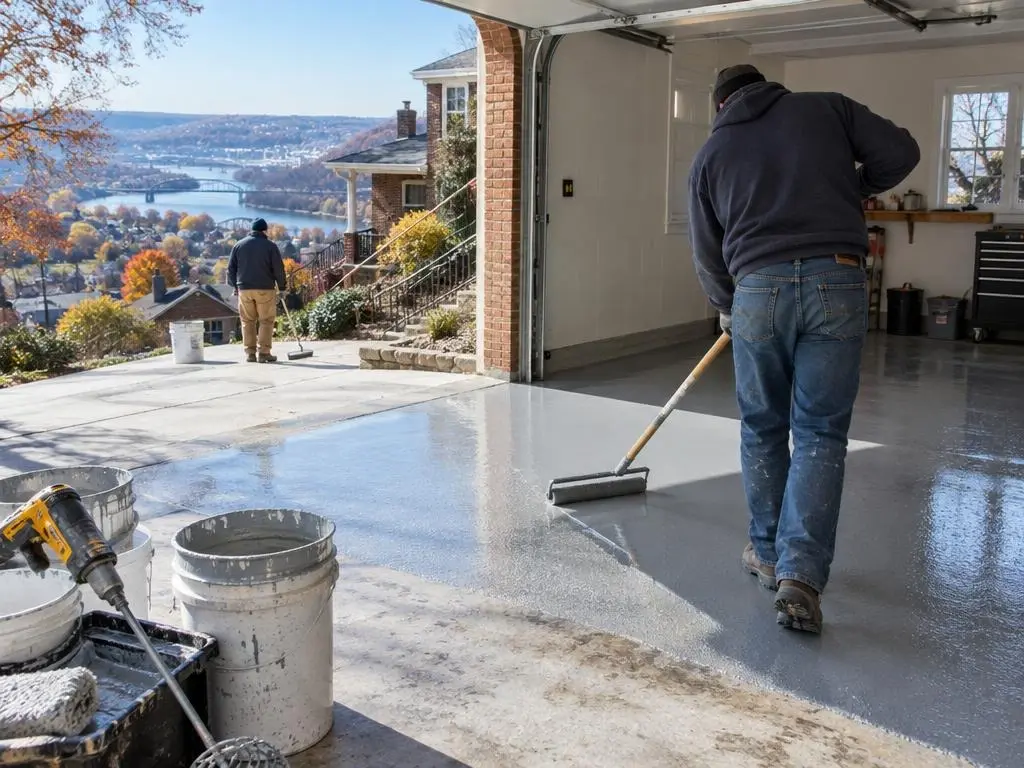
Six ways we coat the slabs Pittsburgh actually has underfoot: salted garages, damp basements, busy shops and commercial floors.
Garage Floor Coatings
Ground, patched and sealed garage floors that keep salt brine, oil and slush on top of the concrete through a western Pennsylvania winter.
Learn more →Flake Epoxy Floors
Vinyl chip broadcast floors in blends that hide salt spots and grit, with texture underfoot and a clear sealed topcoat.
Learn more →Polyaspartic Floor Coatings
Quick-curing coatings that hold up to sun and let you use a garage or shop again within a day or two, even in a short fall window.
Learn more →Metallic Epoxy Flooring
Poured metallic floors that swirl and shimmer in basements, bars, studios and storefronts, no two alike.
Learn more →Commercial & Industrial Epoxy
Seamless, chemical-resistant floors for clinics, labs, warehouses, auto bays and kitchens, scheduled to keep your doors open.
Learn more →Basement Floor Epoxy
Moisture-tested basement floor coatings that seal dusty old concrete and brighten laundry rooms, gyms and playrooms.
Learn more →Towns on Our Route
We work across the city of Pittsburgh and out through the South Hills in Mt. Lebanon, Bethel Park, Upper St. Clair, Baldwin, Bridgeville and South Park Township, east in Monroeville, Penn Hills, Plum and Murrysville, north in Ross Township, Shaler Township, McCandless, Pine Township, Fox Chapel and Bellevue, west near the airport in Moon Township and Robinson Township, down the Mon Valley in West Mifflin and McKeesport, and beyond the county line in Cranberry Township, Peters Township and Canonsburg. The floors change as you go. City homes and river boroughs tend to have older, thinner basement slabs and garages tucked under the house. The postwar suburbs that boomed in the 1950s and 1960s are full of garage floors with decades of salt and oil in them. Newer subdivisions to the north and south have bigger garages on younger concrete that still needs a full grind. Each town page explains what we watch for there.
- Epoxy Flooring in Pittsburgh, PA
- Epoxy Flooring in Mt. Lebanon, PA
- Epoxy Flooring in Bethel Park, PA
- Epoxy Flooring in Upper St. Clair, PA
- Epoxy Flooring in Monroeville, PA
- Epoxy Flooring in Penn Hills, PA
- Epoxy Flooring in Ross Township, PA
- Epoxy Flooring in McCandless, PA
- Epoxy Flooring in Cranberry Township, PA
- Epoxy Flooring in Pine Township, PA
- Epoxy Flooring in Moon Township, PA
- Epoxy Flooring in Robinson Township, PA
- Epoxy Flooring in Bridgeville, PA
- Epoxy Flooring in South Park Township, PA
- Epoxy Flooring in Plum, PA
- Epoxy Flooring in Murrysville, PA
- Epoxy Flooring in Fox Chapel, PA
- Epoxy Flooring in Shaler Township, PA
- Epoxy Flooring in Baldwin, PA
- Epoxy Flooring in West Mifflin, PA
- Epoxy Flooring in McKeesport, PA
- Epoxy Flooring in Bellevue, PA
- Epoxy Flooring in Canonsburg, PA
- Epoxy Flooring in Peters Township, PA
Why Homeowners Call Epoxy Flooring Pittsburgh
Moisture tested before we quote
Below-grade and older slabs often carry vapor. We test first and pick the primer from the reading, not from a guess.
Diamond grinding on every floor
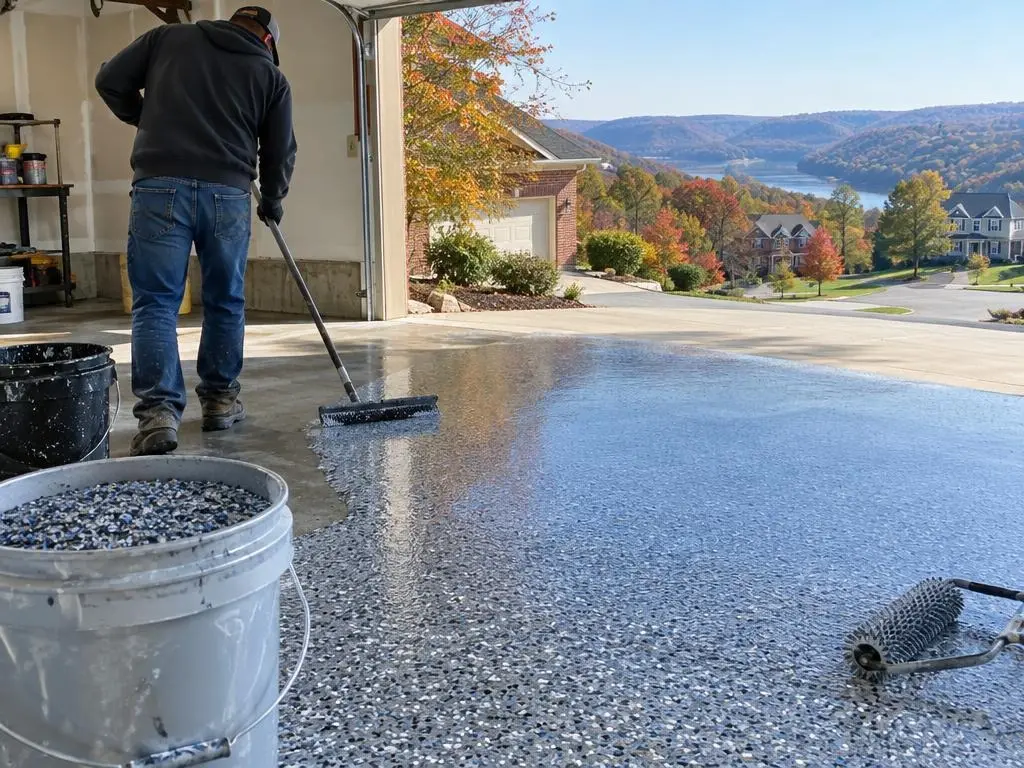
Grinding takes off paint, sealer, salt-damaged paste and stains, leaving solid concrete for the coating to grab.
Readings before every coat
Slab temperature, humidity and dew point are checked each time. If the numbers are off, we wait.
One written price
Your quote shows square feet, prep work, every coat and one total. Any change gets written up and okayed by you before we continue.
Book a Free Floor Estimate
We come to you anywhere in Pittsburgh and the surrounding towns, test the slab and put the price in writing before we leave.